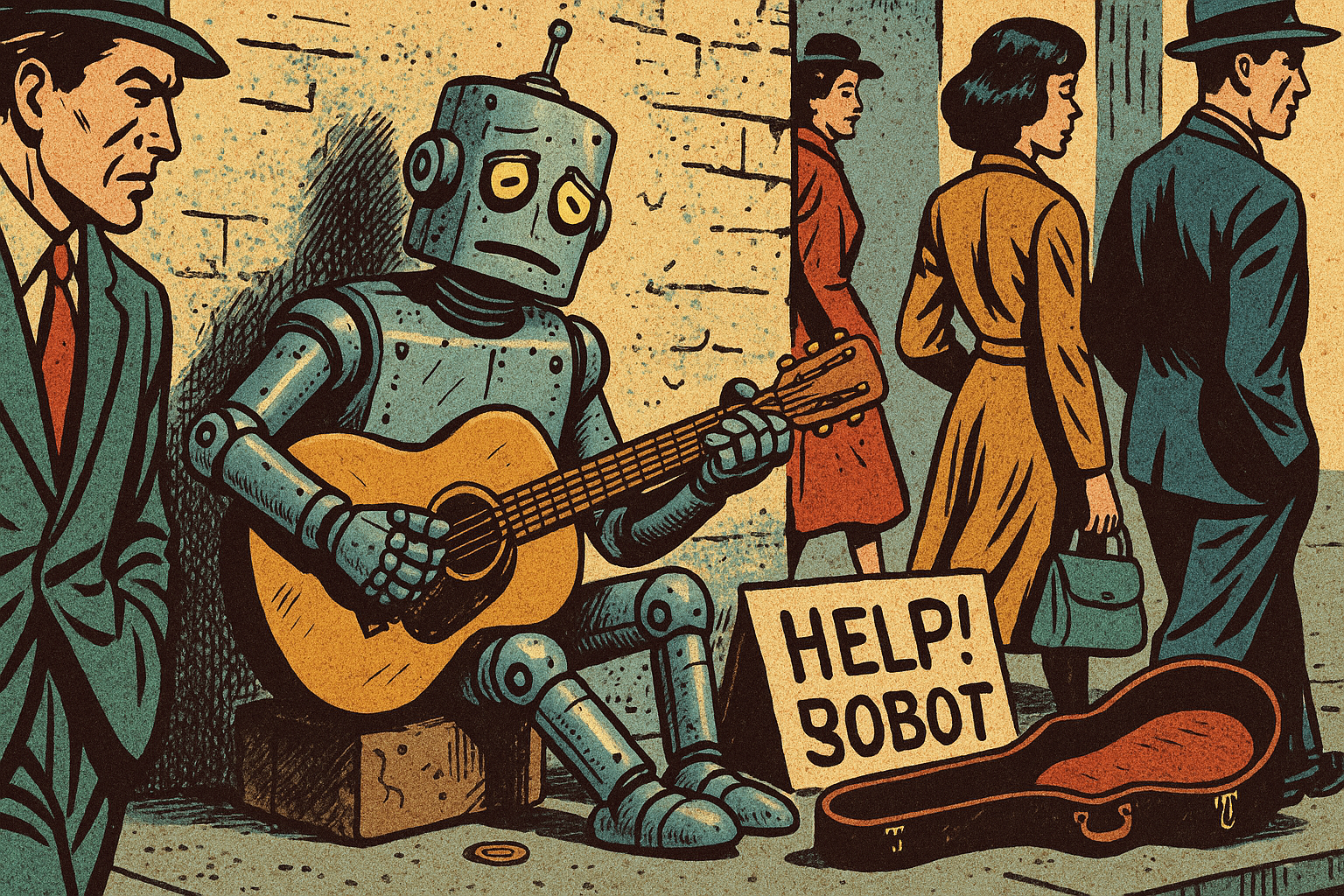
AI music tools like Suno and Udio are genuinely revolutionary. As a musician and song producer, I have worked tirelessly on & off for decades attempting to create radio-ready music in a variety of genres. My failures can be explained by lacking talent in some areas as well as an attempt (at times a necessity) to do things singularly. No band, nor engineer, nor producer, nor label. That is actually virtually (pun intended) impossible; and not something I always did out of choice. But regardless, my music was always close but no cigar metaphorically speaking. In the last month, however, these tools have transformed my experience and output forever. But I am not doing what everybody else is doing. My musical output is not “slop” as they call it now. You will hear it soon enough. With these AI music generation tools, similarly to other LLM that produce text or imagery and video, a single prompt can get you a full track. Including professional sounding arrangement, sound design, even vocals - faster than you can set up a session template in Pro Tools. Platforms like Deezer report that roughly 18% of all new tracks uploaded are now AI-generated - over 20,000 songs per day - and a huge slice of that is what listeners derisively call slop. People think they can hear it. In most cases; you can only feel it. The problem isn’t that the models are incapable of making soulful content; it’s that most people are creatively broke at the inspiration level. They do not know what they want to hear; or if they do - they lack the linguistic description that could even tell a human producer what to do - let alone an AI model. That’s prompt poverty. They can’t afford to make good music since they lack the metaphorical capital requirement: creativity. Prompt poverty is what happens when people lean on AI for everything in the creative process from the very idea, to the structure, sonic distinctions, lyricism, etc. If you start offloading all intention and judgment, nobody should be acting surprised when the results feel empty or aren’t actually sonically pleasing to anybody. It’s not a technical failure on the part of AI, it’s a human failure.
How Most People Use AI In Music Today
If you look at what’s flooding the services - and what Spotify and Deezer are scrambling to filter - you can roughly group the dominant AI music behaviors into a few buckets. Below are those buckets, and a description of what’s wrong with them.1. “make whatever”
There are indications online, and in various social media circles related to this technology, that one of the most common types of prompts is both literally and categorically what I will call “make whatever.” This is the purest form of prompt poverty: literally saying things like “make whatever,” or simply stating a genre such as “chill pop,” or conventional things like “trap beat” with no additional direction, variation, or artistry. It is hard to even imagine how an AI could possibly interpret such prompts without simply stealing from an existing song.- Streaming farms and low-effort users hammer APIs with these vague prompts
- This produces tens of thousands of distributed slop songs every single day
- The same few generic textures, harmonies, and drum patterns show up
- Human beings are not even the target audience of this music, bots are
2. Genre-Specific Slop
A slightly “smarter” version of the same thing, which might be more often done by producers who are trying to get rid of songwriters, looks like: “hardcore punk,” “ambient meditation,” “lofi beats,” etc. The goal here is to pump out slightly less slop than “make whatever,” but basically it is attempting to remove the creative process. On paper, it’s more specific. In reality, it’s still prompt poverty:- You’re tagging a bin in the training data like: “give me something that sounds like this genre” - but you’re not adding any human angle, so it’s empty
- No narrative, no twist, no specific emotional target, no instrumentation choices that say something about you - makes it barely even music
3. Artist Identity Theft
The next category is where platforms are starting to push hard on policy. Deepfaking known artists, and trying to commit the same streaming fraud, is another tactic scammers are employing. Trying to impersonate “Drake” or “Taylor” with original songs, cloning the singers, and even so much as putting fake tracks uploaded under real artist pages. Here the prompt poverty is still a lack of integrity and originality: Creators ask the model to sound as close as possible to an existing artist’s voice, style, or even a specific song, which has prompted labels like Universal Music Group and Warner Music Group to partner with Udio and Suno respectively Then they try to pass it off as that artist, or at least trade on the confusion to grab streams. Spotify and others are moving to require AI disclosures and crack down on deepfakes and impersonation, not because AI itself is banned, but because it crosses legal and ethical lines. It’s still creatively bankrupt. The “creative act” is mostly theft.4. Genre-Bending Covers
One of the most legitimate, musically interesting pockets of AI usage in music right now has been found in transformative covers that are clearly credited. I have seen soul music covers of Korn songs, and things of that nature. This (covers in odd genres) is something punk music has done which I remember from growing up. There would be punk covers of doowop songs, or pop songs, and things like that. By prompting an AI tool to “make Freak On A Leash by Korn, but as a soul song” - you are actually doing something which could be legitimately capitalized if you register the song and split royalties appropriately with the songwriter/publisher. Some appear to be doing these covers for marketing alone, and putting them out mostly for free on YouTube. Still legally murky waters, but much more legitimate than trying to pretend you are an established artist or just prompting to make whatever.5. One-Off AI Personas & Signing AI Artists
Famed producer (and strategic partner with Suno) Timbaland, recently signed an AI artist persona called TaTa, demonstrating an appreciation for the art of crafting the character; but also showing that despite Timbaland’s legendary status as a producer, he is not really a songwriter. Other one-off personas like Xania Monet, or rock groups like Broken Rust and Velvet Sundown, were presented as having caught people off guard without being realized as an AI act. However, the likelihood that people in the normal listening public were actually listening to these groups and being shocked it was AI, is low. From the industry perspective, these one-offs are not really game-changing yet. They are mostly:- Single identities in one genres by a single artist using them like a mask
- Controlled by humans who are strong producers, brand builders, and curators.
- Often weaker on songwriting, since the core compositions are closer to stitched “averages” than to a distinctive writer’s voice.
Why Music Is Where Prompt Poverty Really Breaks
Still images and text have a crucial advantage: you can evaluate them almost instantly. You glance at an image and know if it works. You skim text and can feel its shape without reading every word in depth. That makes it possible to generate at insane volume and still curate. Music is not like that. If a song is three minutes long, it costs you three minutes of actual time to really evaluate it. You can sometimes tell in the first 10–20 seconds that it’s busted, but the deeper problems often hide later:- A verse in the middle where the AI vocalist suddenly mangles your lyrics
- A bridge where the harmony jumps to something tonally wrong
- A final chorus where the melody collapses into a repetitive or off-key loop
AI As An Amplifier, Not An Artist
Prompt poverty is the illusion that if the AI can “do everything,” humans can do nothing and still expect greatness. In reality, every level of the stack still needs a human brain:- Concept: What is this track for? Why make this at all?
- Prompt: Specifying the concept into an actionable form.
- Curation: Which generations are good enough? Which need to be tossed?
- Revision: What do you regenerate, rewrite, or re-prompt?
- Context: How does this fit in a catalog, a label story, a personal voice?